
Ohio Public Records Act and Stark County
Ohio uses two legal tracks to govern public access. County administrative records fall under the Ohio Public Records Act, Ohio Revised Code section 149.43. Court case records fall under the Ohio Rules of Superintendence, specifically Rules 44 through 47. Both tracks start from the same premise: a record is presumed open unless a specific law, rule, or court order restricts it.
Under ORC 149.43, a public office must organize and keep its records so that anyone can inspect or copy them. You do not have to give your name or explain why you want a record. The office may ask you to clarify a request that is too broad to fulfill as written, but it cannot demand identification as a condition of access. The office may charge actual copy costs. If it mails a copy, it may charge mailing costs too. Electronic records follow the same access rule, though there are specific provisions for body-camera and dash-camera video that cap what a law enforcement agency can charge.
A denial must cite the legal authority for withholding. The law is specific on that point. If an office refuses a request without citing a law, the refusal may not hold up. Enforcement is through a mandamus action filed in the Ohio Supreme Court, a court of appeals, or the court of common pleas. A successful requester may recover statutory damages, court costs, and attorney fees.
The second track, the Rules of Superintendence, governs the records that court clerks keep for individual cases. Rule 44 defines what a court record is and what a personal identifier is. Rule 45 sets the presumption that court records are open. Rule 46 covers retention. Rule 47 sets the process for restricting access and ordering redaction. For Stark County court records, the Clerk of Courts follows these rules alongside the Public Records Act.
The screenshot below comes from the official Ohio Revised Code page for ORC section 149.43, the core statute behind every Stark County public records request.
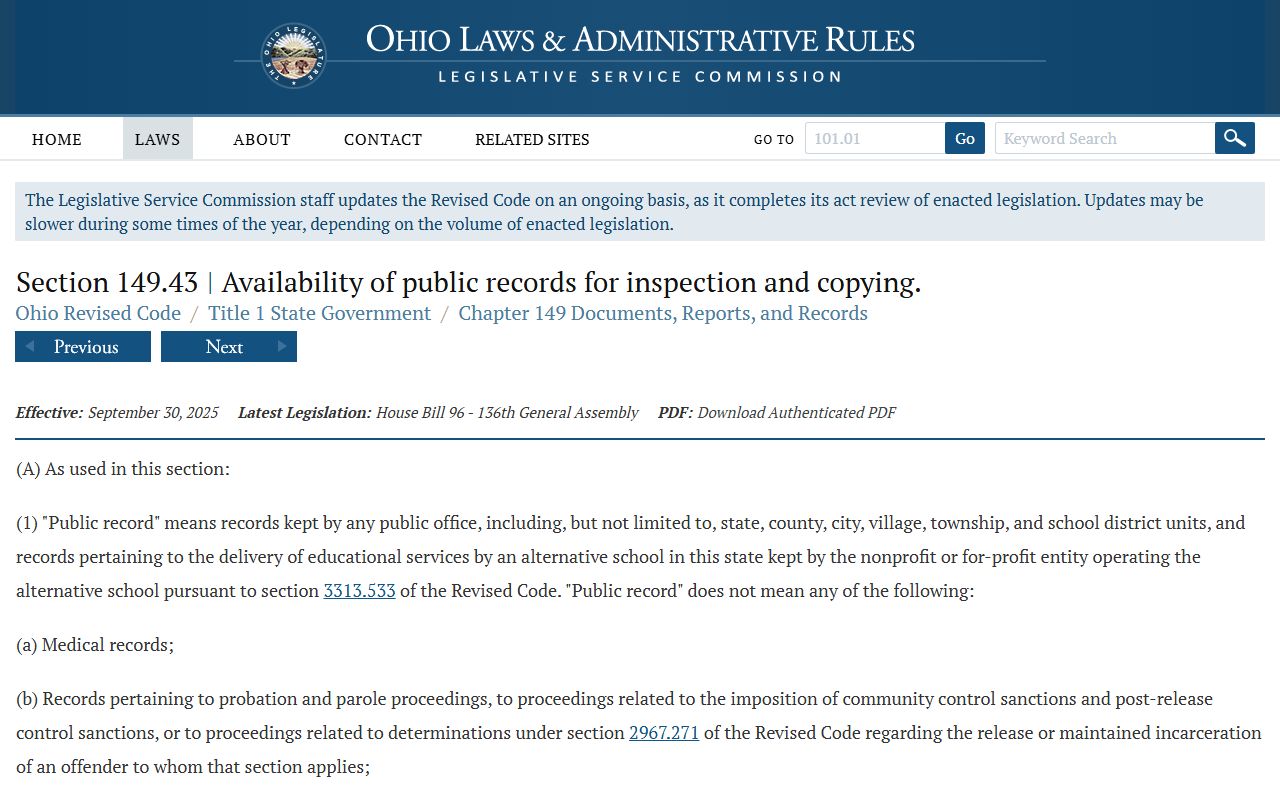
The page shows the full text of the Public Records Act, including the body-camera and dash-camera provisions that many requesters overlook when asking for law enforcement video.
Which Stark County Office Holds the Record
Records in Stark County are split by office. Sending a request to the wrong office delays it. The office that received it will usually tell you to refile, not forward it for you. Know the owner before you write the request.
The Stark County Clerk of Courts holds the case records for the Court of Common Pleas, including general civil, criminal, domestic relations, foreclosure, and appeals. If your record comes from a Common Pleas case, this is your office. The Probate Court at 110 Central Plaza South, Suite 501, Canton, keeps estate filings, guardianship records, and marriage records. For marriage and divorce records, you may need both offices depending on what you want. The three municipal courts, Canton, Massillon, and Alliance, each keep their own traffic and misdemeanor files. The Stark County Sheriff's Office keeps jail records and sheriff-sale records. Other county administrative offices hold their own administrative records.
Here is a quick breakdown by record type:
- Common Pleas case files (civil, criminal, divorce, foreclosure): Clerk of Courts, 115 Central Plaza North, Suite 101, Canton.
- Estate, guardianship, and marriage records: Probate Court, 110 Central Plaza South, Suite 501, Canton.
- Traffic and misdemeanor records: the municipal court named on the citation.
- Jail and sheriff-sale records: Stark County Sheriff's Office.
- County administrative records: the county office that created or maintains the record.
Note: The Clerk of Courts publishes its own public records policy. Ask for a copy if you are unsure whether your request falls under ORC 149.43 or the Rules of Superintendence.
How to File a Stark County Public Records Request
A written request is not always required by law, but it is always the safest choice. It creates a record of what you asked for and when. Most Stark County offices accept requests by email, mail, or in person. Some offices have a form you can use. You are not required to use their form, but it can speed things up because it prompts you to include the information the office needs to find the file.
Keep the request narrow and specific. The more precisely you describe the record, the faster the office can respond. An overly broad request may draw a clarification question, which adds time before the clock really starts running. The steps below walk through a standard request.
- Identify the office that owns the record. Use the breakdown above. Match the record type to the right office before you write a word.
- Write a clear request. Name the office at the top. State the case number or party names, an approximate date, and the exact document or category of documents you want. Be specific. Broad language like "all records" tends to generate a clarification question.
- State how you want the record delivered. Say whether you want to inspect it in person, receive a plain copy, or receive a certified copy. Say how you want it sent: pickup, mail, or email. Certified copies cost more than plain ones and are needed for legal use.
- Ask about fees before paying. If you want a mailed or certified copy, ask the office to confirm the fee before it sends the record. The Stark County Clerk of Courts charges actual copy costs and confirms the amount on request.
- Submit the request and track the date. Send it by email or certified mail if you want a clear timestamp. The office must respond within a reasonable time. If the records take more than a few business days to produce, you can ask for a timeline estimate.
The Clerk of Courts can be reached at 115 Central Plaza North, Suite 101, Canton, OH 44702, by phone at 330-451-7801, or by email at Clerk@starkcountyohio.gov. Office hours are 8:30 a.m. to 4:30 p.m., Monday through Friday.
What a Clear Stark County Public Records Request Includes
A request that includes the right information gets processed faster. Ohio law does not require you to give your name or reason, but giving the office enough detail to find the record is your responsibility. The table below lists the fields that belong in a well-written request. Include every one that applies to your record.
| Field | What to Include |
|---|---|
| Office or court | The exact name of the Stark County office you are writing to (e.g., Clerk of Courts, Probate Court, Sheriff's Office). |
| Case number | The court-assigned case number. Use this if you have it. It is the most reliable identifier. |
| Party names | Full name of the plaintiff or defendant, or the petitioner and respondent. Include any alternate spellings you know. |
| Approximate date | The filing date, the event date, or a date range that helps narrow the search. Even a year is helpful. |
| Document title | Name the specific document if you can (e.g., "final decree," "indictment," "estate inventory," "certified copy of judgment entry"). |
| Copy type | State whether you want inspection only, a plain copy, or a certified copy. Certified copies carry the clerk's official seal and are needed for legal proceedings. |
| Delivery method | Pickup in person, mailed copy, or emailed copy. Confirm with the office whether email delivery is available for the record type you want. |
For Court of Common Pleas records, the case number format usually includes the year and a sequence number. If you do not have the case number, the Clerk's online docket lets you search by party name to find it before you submit a request.
Public Records Fees in Stark County
Ohio law allows a public office to charge the actual cost of making copies. There is no set statewide per-page rate for most records. The Clerk of Courts recovers actual copy costs, and certified copies cost more than plain paper copies because they require the clerk's official seal and an additional step. Always ask for a fee estimate before asking the office to print or mail a large file.
Body-camera and dash-camera video from the Sheriff's Office is a special case. ORC 149.43 sets a statutory cap on what law enforcement may charge for that footage. The cap applies per request, and the office must follow it regardless of file size.
| Item | Amount |
|---|---|
| Plain copies | Actual cost; confirm with the office before requesting a large print job. |
| Certified copies | Confirm cost with the Clerk of Courts. Certification adds an official seal and is required for legal use. |
| Body/dash camera video | Charged under the statutory cap in ORC 149.43. Ask the Sheriff's Office for the current rate. |
| Online payment processor fee | 2.40% of the payment, minimum $2.00. Applies when paying through the Stark County payment portal. |
The processor fee above applies to online payments made through the county portal. It does not apply to in-person payments made by cash or check at the counter. The fee is set by the payment processor, not the county.
Response Times for Stark County Requests
Ohio law requires a public office to respond within a "reasonable time." The statute does not set a fixed number of days, but courts have consistently interpreted that phrase to mean a few business days for routine requests. An office handling a large or complex request can take longer, but it should tell you that and give you a timeline.
Training and model policies matter here. ORC section 109.43 requires county employees who handle public records to complete public records training. The Ohio Attorney General publishes a model public records policy that most county offices adopt. That policy tells employees how to handle requests, how long to keep records, and how to respond to a denial. If an office does not respond in a reasonable time, you can contact the Attorney General's office for guidance before filing a mandamus action.
Stark County offices that have adopted the Attorney General model policy publish it on their websites. The Clerk of Courts policy is available through the clerk's office on request. Ask for a copy if you want to know the exact language the office follows.
Stark County Records That Are Not Public
Not every Stark County record is open. Ohio law carves out several categories and restricts or seals them entirely. The most common ones you will encounter in a court or county records search are listed below.
Juvenile records are restricted under ORC Chapter 2151 and the local juvenile court rules. You generally need to be a party, an attorney, or hold a court order to view a juvenile file. Sealed and expunged records are governed by ORC Chapter 2953. A sealed record should not appear in a public docket search at all, though the underlying case still exists in the court's internal files. Adoption records are confidential under ORC section 3107.17. Mental health proceedings are protected under ORC section 5122.31. Victim personal information is protected under ORC Chapter 2930.
Beyond case records, certain categories in administrative files are also restricted:
- Social Security numbers and financial account numbers are redacted from public documents under the Rules of Superintendence.
- Grand jury materials are not public records.
- Confidential law enforcement investigatory records are exempt while an investigation is open and may remain restricted after it closes.
- Personal identifiers in court documents are redacted under Sup.R. 44 and 47.
If you believe a record was sealed in error, or if you want to challenge a restriction, the right place to start is the court that issued the sealing order. The Clerk of Courts can point you to the right division.
If a Stark County Public Records Request Is Denied
A denial must cite the specific law that allows the office to withhold the record. A denial without a legal citation does not satisfy ORC 149.43. If you get one, ask in writing for the statutory authority for the refusal.
Ohio gives you three courts to file a mandamus action: the Ohio Supreme Court, the court of appeals with jurisdiction over Stark County, or the Stark County Court of Common Pleas. Mandamus is the legal tool for forcing a public office to carry out a duty it is legally required to perform. If the court rules in your favor, you may recover statutory damages of $100 per business day of the delay, up to $1,000, plus court costs and reasonable attorney fees. The damages cap is set by ORC 149.43 and applies only when the office acted in bad faith or ignored an obvious obligation.
For guidance before filing, the Ohio Attorney General's public records team offers informal mediation. You can also contact Ohio Legal Help if you need low-cost or free advice on how to proceed. Many denials get resolved without going to court once the requester cites the statute in a follow-up letter.
Stark County Clerk of Courts Contact
The Clerk of Courts is the main records office for Common Pleas cases and the office most requesters deal with first. Clerk Lynn M. Todaro leads the office. The address, phone number, and hours below apply to routine records requests and certified copy orders.
Stark County Clerk of Courts
115 Central Plaza North, Suite 101
Canton, OH 44702
330-451-7801
Clerk@starkcountyohio.gov
8:30 a.m.–4:30 p.m. Mon–Fri
The clerk handles eFiling, docketing, certified copies, and the naturalization archive. For full detail on the office's responsibilities and how to request a certified copy, see the Clerk of Courts page. For probate and estate records, contact the Probate Court at 110 Central Plaza South, Suite 501, Canton. For Probate Records, that office handles estates, guardianships, and marriage licenses separately from the Clerk of Courts.