
The Stark County Probate Court
The Stark County Probate Court handles wills, estates, guardianships, trusts, adoptions, name changes, marriage licenses, and mental health matters. It is a live court and a records office at the same time, with Judge Curt Werren presiding. It sits in the Stark County Office Building downtown, near the other county offices but separate from the Clerk of Courts counter.
Stark County Probate Court
110 Central Plaza South, Suite 501
Canton, OH 44702
330-451-7755
Court: 8:30 a.m.–4:30 p.m. Mon–Fri
Marriage Dept: 8:30 a.m.–4:15 p.m. Mon–Fri
The court page links Case Search, Records, Forms, an Estate Guidebook, Local Rules, and FAQs. Marriage licenses run through the same court; the marriage and divorce records page covers that side.
Stark County Probate Search Tools
The Probate Court offers an online case search through its eServices system. You can search by case number if you have one, or by the name of a decedent, ward, applicant, or other party. A case number gives the cleanest match, while a name search may return several results to sort through.
Access can be uneven for some probate categories. Estates and guardianships are generally public. Adoptions and mental health proceedings are not. Name changes are usually public unless a court sealed one for safety. Guardianship files can hold sensitive medical and financial material, so expect some redactions or limited access even when the case index is visible.
If a search returns nothing, do not assume the record is missing. The name may be spelled differently, the case may predate online indexing, or the matter may fall in a confidential category. Probate cases also use their own docket numbers, which can carry a prefix. When in doubt, call the Probate Court and give the name, the approximate year, and the type of case, such as an estate, a guardianship, or a name change. Staff can tell you whether a record exists and whether any part is restricted.
- Estate and guardianship indexes are generally open to the public.
- Adoption and mental health records are confidential by statute.
- Name changes are public unless sealed for safety.
- Guardianship files may redact medical or financial details.
Estate Administration in Stark County
Estate administration is the court process for settling what a person leaves behind. Not every estate needs full administration. Some property passes outside probate through joint ownership, payable-on-death accounts, or beneficiary designations. When administration is needed, the Probate Court oversees each step.
The size and makeup of an estate can change the path. A small estate may qualify for a simpler process, while a larger or contested estate runs the full course. The fiduciary, often an executor or administrator, carries real duties: gather assets, notify heirs and creditors, pay valid debts and taxes, and account to the court. The Estate Guidebook linked on the court page walks families through these duties. Getting the steps right matters, because the court must approve the final accounting before an estate can close.
- Determine whether estate administration is needed, since some transfers avoid probate.
- File the application in Stark County Probate Court if the decedent lived in Stark County or Ohio law allows venue.
- Submit the will if one exists, the death certificate, the application, fiduciary paperwork, and the filing fee.
- The court appoints a fiduciary, executor, or administrator.
- The fiduciary gives notice, collects assets, files an inventory, pays valid debts, and handles taxes.
- The fiduciary files accounts and final documents and seeks court approval to close.
What a Stark County Probate Estate File Shows
A public estate file is a record of how the court handled the estate. The fields below are common in an estate case, though some documents stay restricted when they involve medical details or a minor.
- Decedent name and case number with the estate type.
- Filing date and the applicant or fiduciary name.
- The date a will was filed and admitted, if there was one.
- Fiduciary bond, inventory due and filed dates, and account filings.
- Notices to heirs and creditors.
- Orders approving distribution or closing the estate.
Wills become part of the estate file once admitted to probate. A will kept privately before death may not be public.
Reading an estate file is easier once you know the order of events. The case opens with an application, then the court appoints a fiduciary. The inventory lists what the estate holds. Later accounts show what was paid and distributed. Notices confirm that heirs and creditors were told. A closing order ends the case. If a document is missing online, it may be restricted, or its image may simply not be posted, so ask the court rather than assuming it was never filed.
Guardianships and Name Changes
Guardianship is a court process to appoint someone to act for a minor or an incapacitated adult. The process includes an application, a statement of expert evaluation for an adult, notice to interested people, a hearing, an appointment, a bond if required, an inventory, and periodic reports. The Probate Court also links guardianship accounting software through a provider called Societal, a sign of how current its operations are.
Name changes run through the same court. Adult name changes are generally public unless sealed for safety. Minor name changes involve extra notice and child-related sensitivity, so those files can carry more limits. For a step the court requires, check the official forms and local rules.
Adult and minor guardianships differ in important ways. An adult guardianship usually requires a statement of expert evaluation about the person's capacity, and the file can hold private medical detail. A minor guardianship identifies a child, so those records may be redacted or limited. In both, the guardian must file an inventory and periodic reports, and the court keeps watch over the account. That ongoing oversight is why guardianship files can grow over years and why parts stay protected.
Adoption and Mental Health Confidentiality
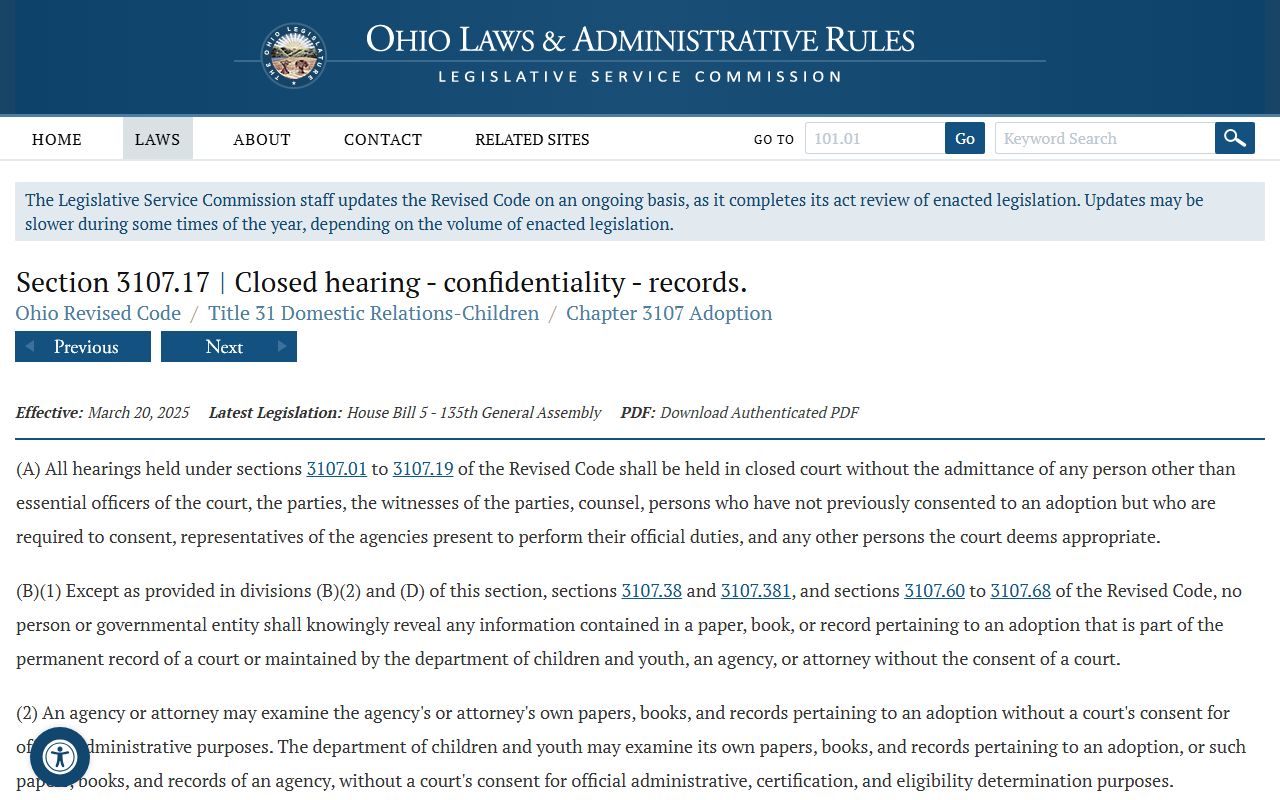
Two probate categories are confidential and should never be marketed as a public lookup. Adoption records are protected by statute. Mental health and civil commitment records are protected as well, even when a docket number is visible. The Probate Court handles these cases, but the files are not ordinary public records.
The image below shows the Ohio adoption confidentiality statute, which restricts adoption records except as the law or a court order allows. You can read it on the Ohio Revised Code § 3107.17 page.
Mental health proceedings carry similar protection under a separate statute. You can review that law on the Ohio Revised Code § 5122.31 page.
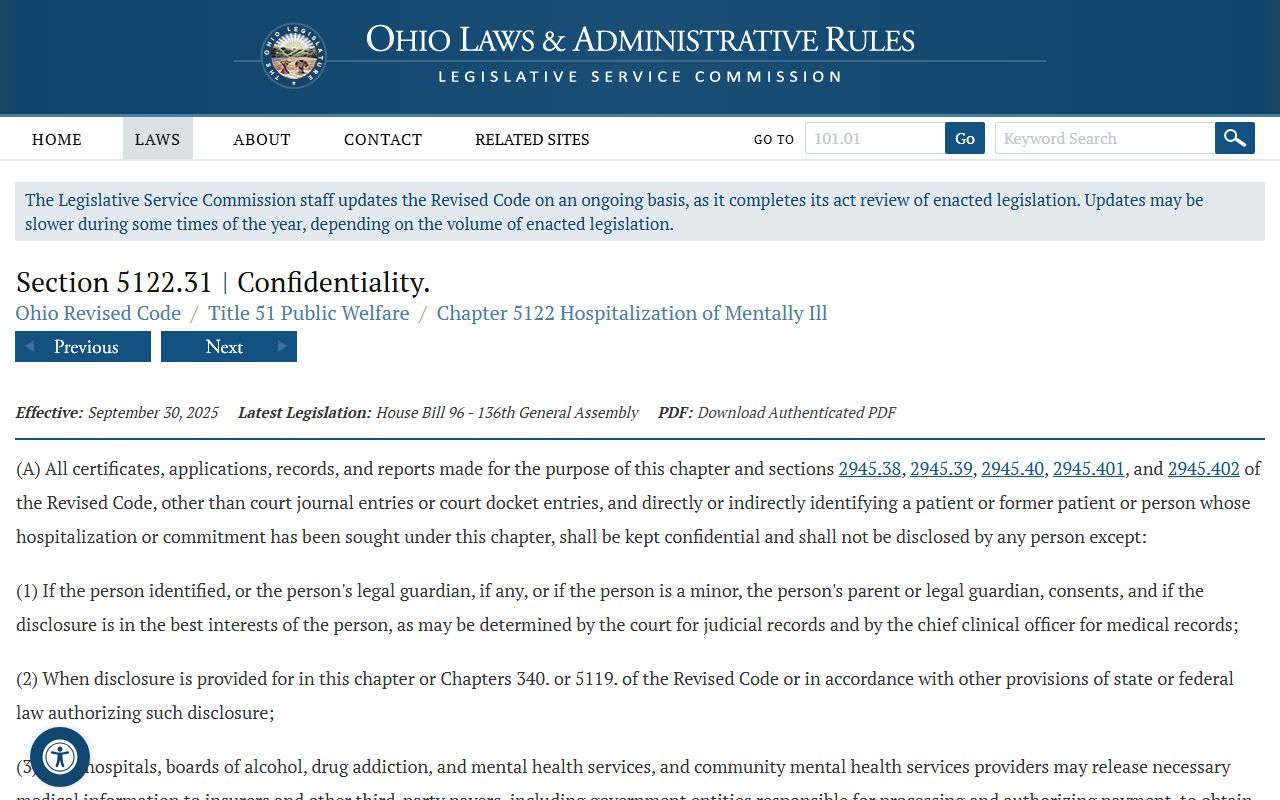
Treat both categories as closed to the public. Access requires statutory authorization or a court order.
This matters for how the Probate Court is described online. The court handles adoptions and mental health cases, but it is not a public adoption or mental health lookup. Marketing those as searchable would mislead people and ignore the law. The honest framing is that the court manages these matters under strict confidentiality, while estate, guardianship, and name-change indexes remain open to the public in the usual way.
Common Probate Terms
Probate uses words that confuse many first-time filers. A short glossary helps you read a case index and the court forms with more confidence.
- Testator
- A person who makes a will.
- Executor
- The person named in a will to carry it out and settle the estate.
- Intestate
- Dying without a valid will, so state law decides who inherits.
- Guardianship
- A court appointment to act for a minor or an incapacitated adult.
- Conservatorship
- Court-supervised management of an adult's affairs, often financial.
Stark County Probate Fees and Forms
Probate filing fees vary by case type and are set by the court, so confirm the current amount on the Probate Court forms and fees page before you file. The verified payment detail below covers the county payment portal. For certified copies, ask the Probate Court directly.
| Item | Amount |
|---|---|
| County payment portal processor fee | 2.40% of payment, minimum $2.00 |
| Probate filing fees | Confirm with Probate Court at 330-451-7755 |
| Certified copies | Confirm with Probate Court |
The court publishes standard forms for estates, guardianships, name changes, and more. For records the Clerk of Courts holds instead, see the Clerk of Courts page, and for the broader access rules, see public records and court records.
Note: Estate and guardianship indexes are public, but adoption and mental health files are confidential and require authorization or a court order.